If I'm going to just keep giving my posts that title, there's not much point in a title, is there? I suppose I could go with "Saturday rambling."
Have you seen the Barbie software engineer flap? Mattel produced a book, "I Can be a Computer Engineer", in which Barbie the engineer needs Steven and Brian's help not only to do her programming, but also to rescue her from a computer virus. She also has a pink heart-shaped flash drive that she wears on a necklace, because otherwise she'd be too forgetful to take backups.
Yeah.
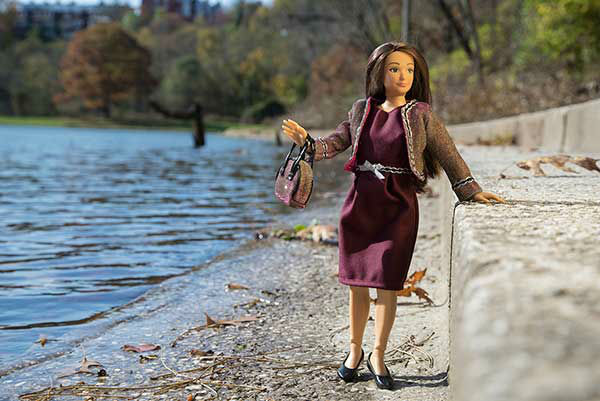
While reading the stuff on various sites, such as Feminist Hacker Barbie, I also kept running into Lammily, a doll made with realistic dimensions for a 19 year old woman. She's more about body image than careers, but I think she looks like she'd write her own code, don't you? She's still a lot thinner than me, but she has room for her internal organs, which Barbie, apparently, doesn't.
One delightful detail is that apparently kids really, really like her. And it's not surprising; if you look at the photos on the website, she looks startlingly, delightfully, human. She reminded me of the fact that I always liked Skipper (back when Skipper was flat chested and had a relatively wide waist) and the mother of the Sunshine Family better than I liked Barbie.
So I bought one. I'm weird that way.
Er.
That appears to be all.
Showing posts with label Feminism. Show all posts
Showing posts with label Feminism. Show all posts
Sunday, November 23, 2014


Sunday, September 21, 2014
TV: Orphan Black and the Reverse Bechdel Test
I posted this on a writing forum, and it occurred to me that in six months I might wonder, "So where was it that I was talking about Orphan Black and the Bechdel test?" So I thought I'd post it here, too.
So, I've considered the Bechdel Test to be a worthwhile concept--on a statistical level--since I heard of it. But it's only after watching a series that almost fails the "reverse Bechdel test" that I really understand the test's significance. I understand why some writers protest the idea that they should somehow make their stories pass the test, but I also understand even more deeply why it's a very bad thing, statistically, that so few movies pass the test.
The Bechdel Test, just so you don't need to Google, is an evaluation of whether a work of fiction has:
1) Two named female characters
2) who have a conversation
3) about something other than a man.
It's not a test that means that a single work of fiction is "good" or "bad." A very good work can fail it. A very bad work can pass it.
I see it as a test that evaluates whether a work has a significant number of important female characters. They don't have to be female characters that are strong or powerful or feminist or intelligent; they just have to be important to the fictional work.
The TV series Orphan Black has a lot of female characters. Sarah, Beth, Kira, Cosima, Alison, Helena, Rachel, Siobhan, Delphine, Gracie, etc. And it's about those characters. About their history, about their battles, about their relationships, about their safety and their happiness and their future.
Many fictional works have the smart guy, the tough guy, the funny guy, the uptight guy, the damaged guy, and the girl. Orphan Black has the smart girl, the tough girl, the funny girl, the uptight girl, the powerful girl, the damaged girl, and so on.
Of course, many of the characters can be described with more than one characteristic--Helena is tough and funny and powerful and extremely damaged; Alison is uptight and smart and tough in some situations and maybe just a little bit psychopathic, and so on. I'm not trying to describe the characters with a bunch of simplistic adjectives. I'm trying to do the opposite--I'm pointing out that Orphan Black covers a great deal of the complex spectrum of human behavior and personality, and it does it with women, instead of with men.
Orphan Black also has men. Felix, Sarah's brother. Donnie, Alison's wife. Daniel, Rachel's monitor. Paul, Beth's boyfriend. Leekie, Rachel's guardian and colleague. Art, Beth's partner on the police force. Vic, Sarah's ex-boyfriend. And so on.
These are great characters, well-rounded and interesting. But are you seeing a pattern here? The men in Orphan Black are defined by their relationship with the women. The story is about the women. It revolves around the women. And that means that when two men are talking to each other, they're almost always talking about a woman. The male characters exist to serve the women's stories.
And it would be hard to insert conversations between those men that aren't about the women. It's hard for Orphan Black to naturally pass the reverse Bechdel test.
Conversations between the men that aren't about the women would seem weird, seem like a waste of screen time. I can only think of one male-to-male interaction that wasn't about a woman--Felix's date with Nicholas. Even that is a little dubious--their first words exchanged refer ot the trouble that they've had with the police, trouble that was about Felix's sister. And their date is interrupted, because of Felix's sister and niece.
Ah, there was that scene between Henrik and Mark about the cow, but we eventually realize that that scene is about the women, even if it's not clear when we see it.
Anyway. Orphan Black is a story about women, in a world packed full of women--strong women, weak women, good women, bad women, smart women, stupid women, women in power and women with no power. Orphan Black amost fails the reverse Bechdel test.
I think that Orphan Black is a great series. But if most movies and TV series revolved around women as totally as Orphan Black does, I suspect that a lot of men would be annoyed. A substantial percentage of movies and TV series revolve around men as totally as Orphan Black revolves around women, and I am annoyed.
The Bechdel Test, again, isn't a test of the worthiness of an individual work. It's a test of the extent to which women exist, where "exist" means that they matter and their stories matter, in the fictional world of television and movies.
Edited to add: Hmm. There's also the conversation between Felix and Tony. But discussing that in any detail would get me into spoilers, which I was trying to avoid.
Link Roundup:
I see that Luz Delfondo at Disrupting Dinner Parties made the point about failing the reverse Bechdel Test long before I did.
Slate has an interesting article, The Brilliant Misandry of Orphan Black. I don't agree with the article's dismissal of the male characters, but it's interesting all the same.
So, I've considered the Bechdel Test to be a worthwhile concept--on a statistical level--since I heard of it. But it's only after watching a series that almost fails the "reverse Bechdel test" that I really understand the test's significance. I understand why some writers protest the idea that they should somehow make their stories pass the test, but I also understand even more deeply why it's a very bad thing, statistically, that so few movies pass the test.
The Bechdel Test, just so you don't need to Google, is an evaluation of whether a work of fiction has:
1) Two named female characters
2) who have a conversation
3) about something other than a man.
It's not a test that means that a single work of fiction is "good" or "bad." A very good work can fail it. A very bad work can pass it.
I see it as a test that evaluates whether a work has a significant number of important female characters. They don't have to be female characters that are strong or powerful or feminist or intelligent; they just have to be important to the fictional work.
The TV series Orphan Black has a lot of female characters. Sarah, Beth, Kira, Cosima, Alison, Helena, Rachel, Siobhan, Delphine, Gracie, etc. And it's about those characters. About their history, about their battles, about their relationships, about their safety and their happiness and their future.
Many fictional works have the smart guy, the tough guy, the funny guy, the uptight guy, the damaged guy, and the girl. Orphan Black has the smart girl, the tough girl, the funny girl, the uptight girl, the powerful girl, the damaged girl, and so on.
Of course, many of the characters can be described with more than one characteristic--Helena is tough and funny and powerful and extremely damaged; Alison is uptight and smart and tough in some situations and maybe just a little bit psychopathic, and so on. I'm not trying to describe the characters with a bunch of simplistic adjectives. I'm trying to do the opposite--I'm pointing out that Orphan Black covers a great deal of the complex spectrum of human behavior and personality, and it does it with women, instead of with men.
Orphan Black also has men. Felix, Sarah's brother. Donnie, Alison's wife. Daniel, Rachel's monitor. Paul, Beth's boyfriend. Leekie, Rachel's guardian and colleague. Art, Beth's partner on the police force. Vic, Sarah's ex-boyfriend. And so on.
These are great characters, well-rounded and interesting. But are you seeing a pattern here? The men in Orphan Black are defined by their relationship with the women. The story is about the women. It revolves around the women. And that means that when two men are talking to each other, they're almost always talking about a woman. The male characters exist to serve the women's stories.
And it would be hard to insert conversations between those men that aren't about the women. It's hard for Orphan Black to naturally pass the reverse Bechdel test.
Conversations between the men that aren't about the women would seem weird, seem like a waste of screen time. I can only think of one male-to-male interaction that wasn't about a woman--Felix's date with Nicholas. Even that is a little dubious--their first words exchanged refer ot the trouble that they've had with the police, trouble that was about Felix's sister. And their date is interrupted, because of Felix's sister and niece.
Ah, there was that scene between Henrik and Mark about the cow, but we eventually realize that that scene is about the women, even if it's not clear when we see it.
Anyway. Orphan Black is a story about women, in a world packed full of women--strong women, weak women, good women, bad women, smart women, stupid women, women in power and women with no power. Orphan Black amost fails the reverse Bechdel test.
I think that Orphan Black is a great series. But if most movies and TV series revolved around women as totally as Orphan Black does, I suspect that a lot of men would be annoyed. A substantial percentage of movies and TV series revolve around men as totally as Orphan Black revolves around women, and I am annoyed.
The Bechdel Test, again, isn't a test of the worthiness of an individual work. It's a test of the extent to which women exist, where "exist" means that they matter and their stories matter, in the fictional world of television and movies.
Edited to add: Hmm. There's also the conversation between Felix and Tony. But discussing that in any detail would get me into spoilers, which I was trying to avoid.
Link Roundup:
I see that Luz Delfondo at Disrupting Dinner Parties made the point about failing the reverse Bechdel Test long before I did.
Slate has an interesting article, The Brilliant Misandry of Orphan Black. I don't agree with the article's dismissal of the male characters, but it's interesting all the same.
Sunday, March 16, 2014
Beauty: Feminism, single standard, and haircuts

I recently participated in a forum discussion about beauty. In that discussion, it became apparent that some participants--a small subset, admittedly--felt that runway models were the ultimate definition of feminine beauty. Not one possible definition--the definition.
Now, the specifics of the definition were a little fuzzy--for example, I'm not sure if those advocating runway-model beauty were aware of the relatively small chest size of most runway models. I suspect that these men might have been dreaming about the actresses who depict models in movies, rather than the actual models. They also seemed reluctant to accept the idea that those women may not look, when they step out the front door to get the paper in the morning, precisely the same way that they look in movies and magazine covers.
But those are nitpicks. What struck me was the idea that there is a single definition of feminine beauty, and any other beauty is not merely different, but inferior. That women who don't strive for this particular brand of beauty are failing to make the most of themselves and resigning themselves to a miserable man-free existence, and that men who don't want this specific kind of beauty in a woman, who want something else, are deluding themselves, or "settling", or so weird that they don't count statistically.
On that topic, The Reluctant Femme led me to The Brainy Femme which led me to Felicia Day's blog post about the reaction to her cutting her hair which led me to "Why Patriarchy Fears the Scissors" from The New Statesman. The writer of that article referred in part to yet another article, one about women who (gasp) cut their hair, the message of which she summarizes as:
The essential argument is: men like long hair, and what sane woman would ever want to do anything that decreases her capacity to please men?Yes. That, yes, is what I was getting from that small percentage of the men in the thread: The incredulous reaction, somewhere between indignant and pitying, to the idea that a woman would have any priority--in particular any priority with regard to her appearance--other than the priority of pleasing men.
Um...
You know, I seem to have veered. The idea that women are frantically working to please men, and that women who have other priorities are deeply disordered, is certainly one that makes me indignant. But that one doesn't seem like as much of a puzzle--I can see the motivation behind it. People in power want to believe that the people not-in-power adore them and want to please them. They want to believe that the powerless are content with the power structure and are striving to fulfill their assigned role in that structure, rather than trying to change it. It's a happy comfy belief, one that could logically be held by some men, hopefully a steadily shrinking number of men.
It's the idea of a single definition of female beauty that I'm curious about. What, exactly, makes that a happy comfy belief? I think that people believe what they wanna believe, so I think that the happy-comfy has to be in there somewhere. Who benefits from the idea of one and only one definition of female beauty?
I suppose that such a definition means that more women are not beautiful. If we accepted tall-and-willowy beauties, and short-and-curvy beauties, and round-faced beauties and long-faced beauties and all kinds of beauties, more women are beautiful. And more women are close to beautiful. And more women can choose which sort of beauty she wants to emulate, or even (gasp) declare their own kind of beauty.
And that would give those women power. Is that it? Is that all? Is it like corporations that try to keep every employee convinced that he's not good enough? Confidence and security leave an opening for reaching for strength and power? But I see a little too much planning there. I find myself wanting to quote that quote about malice and stupidity--I see too much effort put into malice. I think that comfy beliefs are usually about ego or reducing anxiety, and I don't see that here.
But, and ah, then we've got advertising. Advertising does benefit from, and actively work to encourage, insecurity and not-good-enough feelings. Advertising can convince women that they're not good enough, and then, not necessarily even by intent, convince men that they need the premium product, the woman that fits the single definition of female beauty. And so then both sexes see just one definition of female beauty.
Maybe.
Image: Wikimedia Commons.

(Edited to clarify that the folks advocating a single standard were a small percentage of the men involved in the thread, not, as the previous phrasing might have implied, a small number but all the men.)
Friday, March 14, 2014
Fashion Writers: My Bad

I imagined them as Mean Girls all grown up, perching in tiny chairs next to the runway and squealing "Ooh! Ruffles!" Nodding in approving unison as they see that the models have gotten even more skeletal this year, and whispering and tittering when they see a colleague wearing a skirt that's eight millimeters too long.
That's bad enough. But worse, I slipped and fell into the idea that primarily-feminine interests are superficial and airheaded. Well, not all of them, but with regard to fashion. It's related to a trap that digs itself rather frequently--the idea that women can be as serious, as intelligent, as worthy "as men". That idea sounds vaguely empowering for an instant, until it becomes clear that it makes men's worthiness the standard. Men as norm, men as yardstick, women as the deviation struggling to return to the norm. If men are the standard, then that leads dangerously to the idea that women have to give up anything uniquely feminine in order to be worthy, or at least normal.
And, yes, I know that there are no new thoughts here. Feminism has been fighting over traditional femininity since, well, forever. Whether to embrace it as part of a proud identity, whether to reject it as a male-imposed standard, and any number of other positions in between and scattered around, including the position that it's men, in being deprived of things like, oh, a glorious scarlet crystal-pleated skirt (I still don't like ruffles), who are being suppressed by a patriarchal society.
The point where I owe fashion writers an apology is in assuming that they're all trying to undermine the power of women. Actually, the bigger point where I owe fashion writers an apology is in assuming that they're stupid.
I'm sorry.
Now, this doesn't mean that I've seen any specific fashion writer as stupid. In fact, that's where I should have seen the fundamental wrongness of my premise. I've never encountered a stupid fashion writer. I just assumed that the writers that I encountered were all exceptions, intelligent people adding worth to a subject that has no inherent worth.
Linda Grant, author of The Thoughtful Dresser? Exception. Elizabeth Cline, the author of Overdressed? Exception. The writers of the articles in Fashion Projects magazine? The fashion critics that they write about? Amanda Stuart, the author of a biography of Diana Vreeland? Diana Vreeland herself? Every blogger that I've encountered in the perfume-blogging and sewing worlds who's written about fashion? Exceptions, exceptions, and more exceptions. Josephine Picardie, the author of My Mother's Wedding Dress? The final exception.
Why final? Well, reading My Mother's Wedding Dress was the point where I finally and firmly realized that when you can't find an exception to the exceptions, the rule is wrong. I think that this book did the job because I couldn't say, oh, well, she just happens to occasionally talk about clothes as a way to address bigger issues. The author worked for British Vogue, and many of the essays in the book come out of interviews that she did in covering fashion. She's a fashion writer. She's a fashion critic. There's no getting out of it. And she's very smart, with things to say.
Yes, she uses clothes to address bigger issues. I realize now that they all do. Fashion criticism is not all about ruffles and hemlines, any more than perfume criticism is all about analyzing the notes or movie criticism is all about special effects or camera angles. The narrower subject has inherent interest, yes, but the subject also has plenty to say about the rest of the world.
Sorry.
Why didn't I know this? Why didn't I assume that an area that fascinates so many women must also have something to appeal to intelligence? Why, when I know that people giggle at the phrase "perfume criticism", did the very phrase "fashion criticism" strike me as vaguely funny?
Again with the sorry.
I feel as if I owe someone a nice fruit basket.
Image: Wikimedia Commons.

Thursday, December 1, 2011
Link: In case you missed it (Basenotes thread about feminine perfume packaging)

Stereotypical "Feminine" Bottles, Packaging: Irritating? Offensive? Humiliating?
and thought you folks might too, if you haven't already run across it.
Image: By tanakawho. Wikimedia Commons.
.jpg)
Monday, November 21, 2011
Rant: "I'm not a feminist, but..."

Over at NaNoWriMo, there was a recent thread about writing female characters. Women, intelligent articulate women, were concerned about writing female characters that might put off male readers, or might give the wrong impression of women. Some of them were just writing male characters instead. I realized that I believed that ideas of women about women were improving over time, that women would have more confidence and strength in themselves than when I was younger. And I'm realizing that, no, we seem to be losing ground in the nearly-twenty years since I was in my twenties. So I ranted the following rant, and after I thought about it, I I brought it over to the blog:
I've often heard the phrase, "I'm not a feminist, but..." and I've never understood it. No matter how many times I try, I can't get my mind around it.
Now, the logic part of my brain has an interpretation. It interprets the phrase to mean that women have somehow acquired a gut-level negative response to the term "feminist", and that as a result, when they advocate the ideas that a feminist advocates, they still can't bring themselves to call themselves feminists. But I don't have that gut-level reaction, so I can't understand it emotionally.
I assume that the reaction has been achieved by the people who take the most extreme positions taken by anyone who has called themselves a feminist, add them to extreme positions that have never been taken by any feminist at all or in fact any person at all, attribute them to all feminists, and publicize the result as far and wide and loudly as they possibly can. Add a few thousand incidences of someone saying, "feminist" on television with that combination of fear, contempt, and pity, and the job is done.
The result is to make women feel that they have to take their focus off their goals and instead focus on being perceived to be pursuing those goals the "right" way, and apologize for even having those goals, for fear that others will misunderstand. A woman who wants a fair shot at a job, or who wants to wash the dishes no more often than the other adult in the house, feels that she has to clarify that she doesn't also want to kill all men, or outlaw fatherhood, or whatever crazy position has been falsely attributed to feminists this week. And when the fear of being perceived that way is a factor, she'll quite often dismiss her own concerns as trivial, rather than risk it.
So she's distracted from her goal, or induced to abandon it altogether. She feels the need to distance herself from other women that might have scary feminist views, because she's been told that lots of women have those views, and she doesn't want to be associated with them. The result is to dilute her focus, dilute her sense of purpose, and suppress any cooperation and unity among women. The strategy takes the natural tendency of women to find a consensus and to work with others, and turns it to making women afraid to work with other women, and afraid to find solutions to their common problems. Women want to be reasonable, and substantial forces are aimed at making a woman feel that any concern for her rights as a woman makes her part of an unreasonable crowd.
It's wrong. I'd go so far as to call it evil. And it should be fought fiercely, even if that fight does raise the risk of someone asking, with that wide-eyed, please-don't-eat me, eew-I'd-never-want-to-date-you, air, "Are you a feminist?" Please, don't ever again say, "I'm not a feminist, but..." Fight for what you think is right without apologizing, and if that means you're a feminist, embrace the label.
Image: Wikimedia Commons.

Subscribe to:
Posts (Atom)